
Interiors Market Atlanta
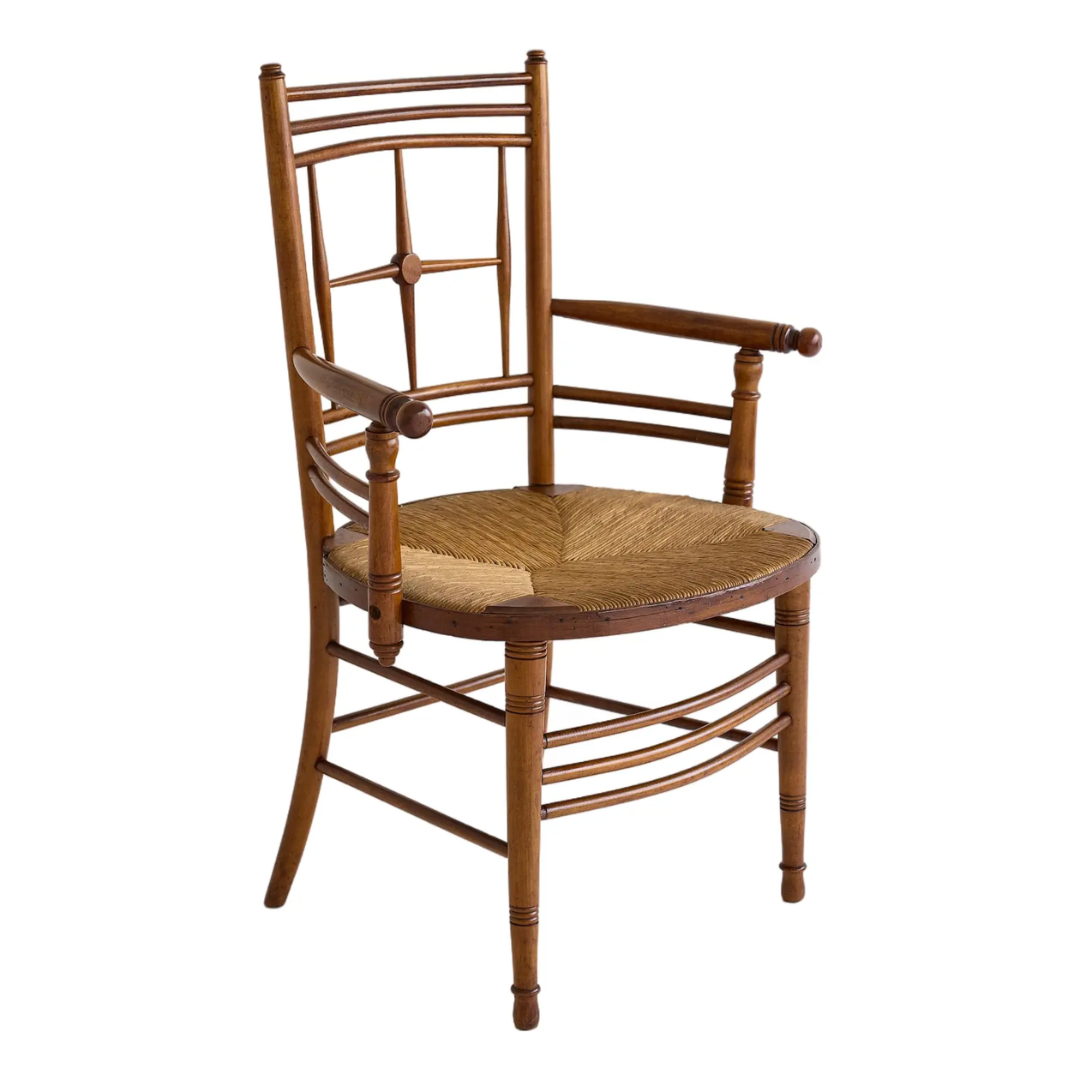
Morris & Co. Armchair From the Sussex Line, London, 19th Century
Morris & Co. Armchair From the Sussex Line, London, 19th Century
Couldn't load pickup availability
Dimensions: 26ʺW × 19.75ʺD × 38ʺH
Armchair, from the Sussex range of chairs by Morris, Marshall, Faulkner & Co., later Morris & Co., English 1870-1900
The armchairs and chairs, which have round seats and square backs with a design of crossed and horizontal rails, are examples of the different designs developed for the Sussex range of rush-seated chairs. The range was illustrated by Morris & Co., in their catalogue, Specimens of Furniture Upholstery & Interior Decoration, n.d. (c. 1912), page 63.
It is not clear who was responsible for the design of the round-seated armchair and chair nor when the design was first introduced into the Sussex range. This design was attributed to Ford Madox Brown, one of the original partners in Morris, Marshall, Faulkner & Co., in a periodical, The Furnisher, III, 1900-1, pp. 61-3. If Madox Brown was responsible for the design, it was presumably before the firm was re-organised under the direction of William Morris who renamed it Morris & Co. in 1875.
The 'Sussex' range, the most widely known furniture associated with William Morris, remained in production for over fifty years and was still advertised in the firm’s catalogue of about 1912. The turned frame and rush seat of this armchair were inspired by traditional rural furniture techniques.
A distinguished example of Aesthetic Movement seating furniture, this armchair embodies the design principles championed by the reformist makers and theorists of late Victorian Britain.
The back is constructed from slender turned uprights with finials, connected by a grid of horizontal and diagonal spindles converging on a central turned boss, a motif strongly characteristic of the Aesthetic and early Arts and Crafts idiom. The arms curve outward to ball-turned terminals supported on columnar balusters, while the front legs are finely ringed and taper to neat feet. A set of curved horizontal stretchers unifies the underframe with the same rhythmic quality found in the back.
The seat is woven in rush, a natural material favored by Morris and Co. for its honesty and simplicity, consistent with the movement's rejection of Victorian excess. The fruitwood frame, likely cherry or pear, retains a warm honey-toned patina developed over more than a century.
Chairs of this model were produced for both domestic and artistic interiors and are closely associated with the progressive cultural milieu of the 1870s and 1880s. This example is structurally sound and presents with considerable elegance.
Resources:
Victoria & Albert Museum (as documented) item 0170974/armchair-brown-ford-madox
Share